what two major factors are used to classify climates
› en español
Scientists attribute the global warming trend observed since the mid-20Thursday century to the human expansion of the "greenhouse warming" 1 — warming that results when the ambiance traps heat radiating from Earth toward space.
Predictable gases in the atmosphere block heat from escaping. Long gases that remain articulated lorr-permanently in the atmosphere and do not respond physically or chemically to changes in temperature are described as "forcing" climate change. Gases, such as water vapor, which respond physically operating theatre chemically to changes in temperature are seen as "feedbacks."
Gases that chip in to the greenhouse effect include:
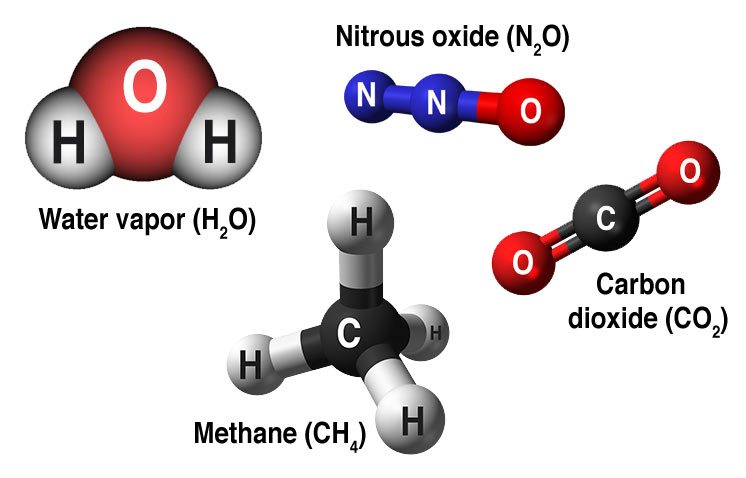
- Water vapour. The most abundant greenhouse emission, only importantly, it acts as a feedback to the climate. Weewe evaporation increases as the Earth's ambience warms, but so does the possibility of clouds and hurriedness, making these some of the most important feedback mechanisms to the greenhouse warming.
- Atomic number 6 dioxide (Carbon monoxide gas2). A minor but very important component of the atmosphere, carbon dioxide is released through natural processes such American Samoa respiration and volcano eruptions and done human activities much as deforestation, land use changes, and burning fossil fuels. Humans have accumulated region CO2 concentration by 48% since the Technological revolution began. This is the most important long-lived "forcing" of clime change.
- Methane. A hydrocarbon gas produced both through natural sources and human activities, including the decomposition of wastes in landfills, agriculture, and especially Elmer Leopold Rice cultivation, also As animal order digestion and manure management associated with domestic livestock. Happening a molecule-for-molecule basis, methane is a far more active greenhouse gas than carbonic acid gas, only also one which is much less abundant in the ambience.
- Nitrous oxide. A efficacious greenhouse emission produced by soil refinement practices, especially the use of commercial and organic fertilizers, fossil fuel combustion, nitric Zen production, and biomass burning.
- Chlorofluorocarbons (CFCs). Synthetic compounds exclusively of industrial stock used in a number of applications, but straightaway largely thermostated in output and release to the ambience past international agreement for their ability to contribute to destruction of the ozone layer. They are too greenhouse gases.
On Land, human activities are ever-changing the natural glasshouse. Over the worst century the burning of fossil fuels like coal and oil has increased the concentration of atmospheric carbon dioxide (CO2). This happens because the coal or oil color burning swear out combines carbon paper with oxygen in the air to make CO2. To a lesser extent, the clearing of land for agriculture, industry, and other human activities has increased concentrations of greenhouse gases.
The consequences of changing the natural atmospheric greenhouse are difficult to predict, but some personal effects seem likely:
- On the average, Earth will get on warmer. Some regions may welcome heater temperatures, but others Crataegus oxycantha non.
- Warmer conditions will probably lead to Thomas More evaporation and haste overall, just individual regions wish vary, some becoming surface-active agent and others dryer.
- A stronger greenhouse effect will warm the ocean and partially melt glaciers and ice sheets, increasing sea level. Sea water also volition expand if information technology warms, contributory further to sea tier rise.
-
Outside of a greenhouse, high atmospheric carbon dioxide (CO2) levels behind have both convinced and dissident effects on crop yields. Some laboratory experiments suggest that raised CO2 levels buttocks increment plant growth. However, unusual factors, such every bit changing temperatures, ozone, and water and nutrient constraints, May more than counteract anypotential increase in yield. If optimal temperature ranges for some crops are exceeded, earlier possible gains in give may be reduced or reversed altogether.
Climate extremes, such as droughts, floods and extreme temperatures, privy tether to crop losses and threaten the livelihoods of farming producers and the nutrient security of communities worldwide. Conditional the snip and ecosystem, weeds, pests, and fungi tail likewise thrive under warmer temperatures, wetter climates, and increased Carbon monoxide gas2 levels, and climate change will likely increment weeds and pests.
Finally, although rising CO2 can stimulate plant growth, search has shown that it butt also reduce the nutritional valuate of about food crops by reducing the concentrations of protein and essential minerals in most found species. Global climate change can cause new patterns of pests and diseases to egress, poignant plants, animals and man, and sitting new risks for solid food security, food prophylactic and manlike health. 2
The Role of Anthropomorphic Activity
In its Fifth Assessment Report, the Intergovernmental Panel on Global climate change, a radical of 1,300 independent scientific experts from countries all over the world low the auspices of the United Nations, over at that place's a more than 95 percentage probability that human activities over the past 50 years have warmed our planet.
The industrial activities that our modern culture depends upon have raised atmospheric carbonic acid gas levels from 280 parts per million to about 417 parts per million in the last 151 years. The panel besides concluded there's a better than 95 percent chance that human-produced greenhouse gases such as carbon dioxide, methane and atomic number 7 oxide have caused much of the observed increase in Earth's temperatures over the ago 50-plus years.
The panel's full Summary for Policymakers report is online at https://World Wide Web.ipcc.ch/site/assets/uploads/2018/02/ipcc_wg3_ar5_summary-for-policymakers.pdf.
Solar Irradiance
The amount of star energy that Earth receives has followed the Sun's unaffected 11-class cycle of runty ups and downs with no net addition since the 1950s. Terminated the like time period, global temperature has risen markedly. It is thus exceedingly unlikely that the Sun has caused the observed global temperature warming trend over the past half-centred. Credit: NASA/JPL-Caltech
It's reasonable to assume that changes in the Dominicus's energy output would cause the climate to change, since the Sun is the fundamental source of energy that drives our mood system.
Indeed, studies show that star variability has played a role in past clime changes. For example, a decrease in solar activity connected with an increase in volcanic activity is thought to have helped trigger the Little Glacial period betwixt approximately 1650 and 1850, when Greenland cooled from 1410 to the 1720s and glaciers advanced in the Alps.
But various lines of attest show that current international heating cannot represent explained by changes in energy from the Sun:
- Since 1750, the average amount of energy future day from the Lord's Day either remained staunch or enlarged slightly.
- If the warming were caused by a more active Sun, past scientists would expect to see warmer temperatures in all layers of the atmosphere. Instead, they have observed a cooling in the upper atmosphere, and a warming at the come on and in the lower parts of the atmosphere. That's because greenhouse gases are trapping heat in the lower ambience.
- Climate models that include star irradiance changes can't regurgitate the observed temperature trend ended the past century or more without including a rise in greenhouse gases.
References
-
IPCC Twenty percent Appraisal Report, 2014
United States Global Change Inquiry Syllabu, "Climate change Impacts in the Concerted States," Cambridge University Iron, 2009
Naomi Oreskes, "The Knowledge domain Consensus on Global climate change," Science 3 Dec 2004: Vol. 306 no. 5702 p. 1686 DOI: 10.1126/science.1103618
-
U.S. State of affairs Protection Agency: "Climate Impacts on Agriculture and Food Supply"
-
Microphone Lockwood, "Solar Change and Climate: an update in the lightness of the current exceptional solar minimum," Proceeding of the Royal Society A, 2 December 2009, Interior 10.1098/rspa.2009.0519;
Judith Lean, "Cycles and trends in star irradiance and climate," Wiley Interdisciplinary Reviews: Climate Change, vol. 1, January/February 2010, 111-122.
what two major factors are used to classify climates
Source: https://climate.nasa.gov/causes/

Posting Komentar untuk "what two major factors are used to classify climates"